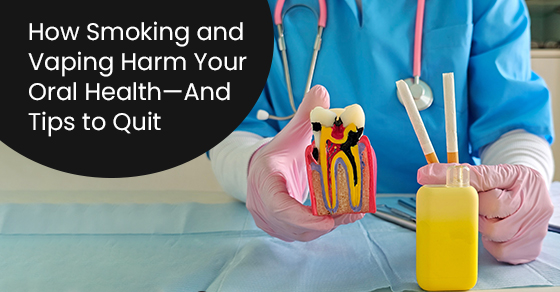
Smoking and vaping do more than leave behind a lingering smell or surface stains. They can change what is happening inside your mouth every day, from how well your gums fight infection to how quickly tissues heal after treatment. For adults who smoke or vape, those changes can build quietly over time, then show up as discomfort, visible damage, or more serious dental problems.
That is why this topic deserves attention before symptoms become hard to ignore. Problems tied to smoking and oral health can affect how your smile looks, how your mouth feels, and how well dental treatment works. Below, we break down the main effects and share practical steps that can help you protect your teeth and gums.
Tobacco products and vaping devices can interfere with oral health in several ways at once. Some effects are easy to notice, like bad breath, staining, or a dry mouth that never quite feels comfortable. Others develop more gradually, including infection below the gumline, slower healing, and changes in oral tissues that may not be obvious without a dental exam.
That combination is part of what makes the issue so serious. A person may focus on the cosmetic side while deeper damage continues in the background. Understanding the full picture makes it easier to see why prevention, early treatment, and regular checkups matter.
One of the clearest links between smoking and oral health is the increased risk of gum disease. Smoking can weaken the body’s immune response, which makes it harder to control the bacteria that collect around the teeth and under the gums. Vaping may not involve tobacco smoke in the same form, but it can still irritate soft tissues and contribute to inflammation.
Bleeding gums, swelling, tenderness, and gum recession are common warning signs. In some cases, symptoms seem milder than expected because smoking can reduce blood flow and mask obvious inflammation. That does not mean the gums are healthy. It can mean damage is progressing without the usual visible signals.
Over time, untreated gum disease can lead to bone loss, loose teeth, and more complex periodontal treatment. Healing may also take longer, which makes early intervention even more important.
Staining is often one of the first changes people notice. Nicotine and tar can leave teeth yellow, brown, or unevenly discoloured, especially along the gumline and between teeth. Those stains can become difficult to remove with brushing alone.
For many adults, the issue is not only cosmetic. A stained smile can affect confidence in social and professional settings. Vaping may not always create the same heavy tar staining seen with cigarettes, but it can still contribute to dullness, residue buildup, and changes in the appearance of enamel over time.
A healthy mouth depends on saliva. It helps wash away food particles, neutralize acids, and keep bacterial growth under control. Smoking and vaping can reduce saliva production, leaving the mouth dry and more vulnerable to irritation.
Once that protective moisture drops, bacteria have an easier time multiplying. That can mean persistent bad breath, a sticky or uncomfortable feeling in the mouth, and a higher chance of cavities or oral infections. Dry mouth also makes everyday eating and speaking less comfortable, which is one reason some patients notice the effects long before they connect them to their habits.
Blood flow plays a major role in recovery, and smoking can restrict it. As a result, the mouth may heal more slowly after extractions, implants, deep cleanings, or gum treatments. Tissues that need oxygen and nutrients to repair themselves do not recover as efficiently when circulation is reduced.
That slower healing can increase the chance of pain, irritation, infection, or treatment complications. For patients planning a dental procedure, this is often one of the most practical reasons to cut back or stop. Even a short-term change can support a better recovery process.
Tobacco use is strongly associated with a higher risk of oral cancer. While not every sore spot or irritation is a sign of cancer, changes that do not go away deserve prompt attention. Warning signs can include persistent mouth sores, unusual lumps, red or white patches, difficulty swallowing, or numbness in part of the mouth.
Regular dental checkups are valuable here because screening is not limited to teeth and gums. Dental visits also give your provider a chance to monitor changes in the cheeks, tongue, lips, and other oral tissues. Early detection can make a major difference.
Quitting does not usually happen in one perfect step, and it does not need to. A realistic plan is often more effective than a dramatic one that falls apart after a few days. Start by noticing your patterns. Do you smoke after meals, while driving, or during stressful moments? Identifying those routines can help you prepare substitutions instead of relying on willpower alone.
A few practical steps can help:
You can also protect your mouth while you work on quitting by brushing thoroughly, cleaning between your teeth daily, and booking regular professional cleanings. Those habits do not erase the risks, but they can reduce buildup and make it easier to catch problems earlier.
Smoking and vaping can affect your gums, teeth, saliva flow, healing, and long-term risk of serious disease. Paying attention to oral health early makes it easier to manage those effects before they become harder to treat. At Oakville Place Dental, we provide preventive care, treatment, and ongoing support for patients who want to protect their smile and address concerns linked to smoking and oral health.
Reach out to Oakville Place Dental today at 1-905-842-6030, email us at rochelle@dentistoakville.com or click here to get in touch online.
Yes, vaping can still affect oral tissues. Smoking is more strongly associated with heavy staining and oral cancer risk, but vaping can still contribute to dry mouth, irritation, inflammation, and bacterial buildup. The risks are not identical, but neither habit is harmless.
Some effects can show up quickly, including bad breath, dry mouth, and surface staining. Other problems, such as gum disease, recession, and delayed healing, tend to develop over time and may worsen without regular dental care.
Yes. Quitting can support better gum healing, improve circulation, reduce staining over time, and lower the risk of future complications. The sooner you stop, the more opportunity your mouth has to recover.
Regular checkups, professional cleanings, and periodontal care can help manage the higher risks smokers face. Ongoing dental visits make it easier to monitor gum health, treat problems early, and support better long-term oral health.
 0 Comment
